Who Created The Iconic Vintage Look Of Winnie-The-Pooh?
This year marks the centennial anniversary of the publication of the first-ever Winnie-The-Pooh book, a children’s story so iconic that vintage prints to this day are hung up in bedrooms and studies around the world.
The 1926 book Winnie-The-Pooh, its sequel The House At Pooh Corner, its iconic cast of characters and the setting of the Hundred Acre Wood, have all become iconic generational favourites, as children who loved the books pass them down when they become parents and grandparents.
What is so fascinating about Pooh Bear is that he effectively has three separate creators: the author of his books, the imaginative child who created the world he lived in, and the artist whose pencil sketches brought the Hundred Acre Wood to life.
Who Wrote Winnie-The-Pooh?
What makes Winnie-The-Pooh so unusual is that the author of the first two books, A.A. Milne, was not initially known as a children’s author.
Initially a writer for popular satirical magazine Punch, he provided a mix of poetry and somewhat whimsical essays, alongside which he worked on novels, short story collections and newspaper articles, as well as a screenwriter for several early films.
Before the release of the first Pooh Bear book, Mr Milne was best known for The Red House Mystery, a 1922 country house that was immensely popular at the time but has since been overshadowed despite its lengthy print run.
Around the time it was serialised, Mr Milne bought a teddy bear from Harrods’ department store for his son, Christopher Robin Milne, which inspired a poem in the 1924 children’s poetry collection When We Were Very Young, which inspired Winnie-The-Pooh.
He only wrote two books featuring the character, with 1928’s The House at Pooh Corner serving as a farewell to the characters, the setting and childhood itself.
Who Invented Winnie-The-Pooh?
Whilst Mr Milne was the writer of the two books that brought the bear to life, the true inventor of Winnie-The-Pooh was his son and the main character of the stories, Christopher Robin.
When the family moved to Cotchford Farm in East Sussex, nearby Ashdown Forest became the Hundred Acre Wood, and several landmarks on maps were inspired by parts of the wood.
He struggled with the fame of being Christopher Robin, but maintained a close relationship with his father until he died in 1956 and eventually found his calling in bookshop ownership.
Who Designed Winnie-The-Pooh’s Vintage Look?
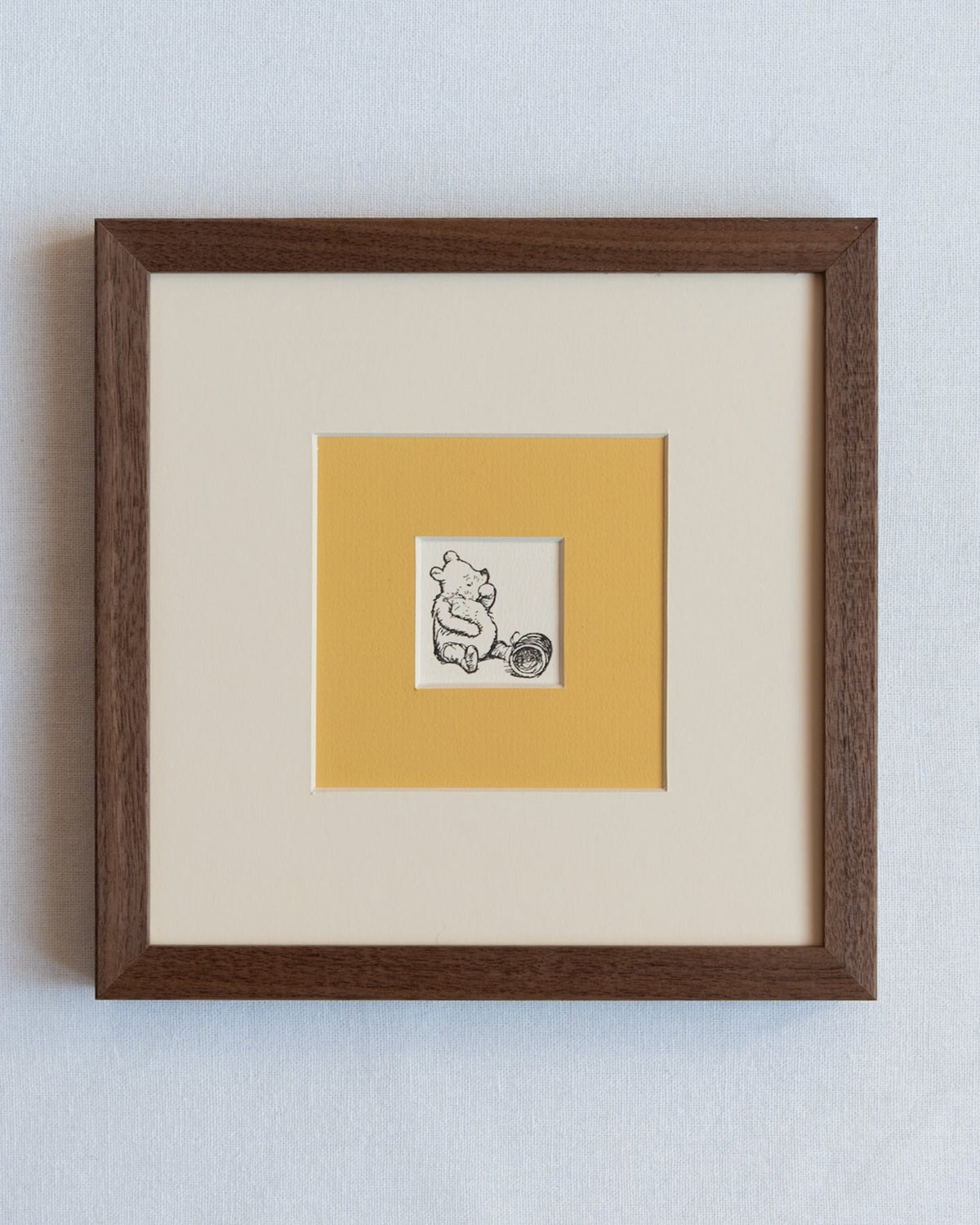
The third author was Ernest Howard Shepard, the man who brought the Hundred Acre Wood to life through his illustrations and drew the now-iconic map that appears in the first book.
Before sketching Pooh Bear, E.H. Shepard was a very successful illustrator who also worked for Punch, as well as illustrating not only the early Winnie-The-Pooh books but also The Wind In The Willows and illustrated editions of several literary classics.
A.A. Milne ensured that Mr Shepard received a share of royalties and a share of the credit, as his evocative sketches were critical to the book’s success.
Unfortunately, he resented the fame, as he felt it overshadowed his vast body of other work.
Why Does Disney’s Version Of Winnie-The-Pooh Look Different?
The classic version of Winnie-The-Pooh is somewhat different to the bright yellow bear with the red t-shirt most associated with the Walt Disney version of the character seen in films such as Winnie the Pooh and the Blustery Day.
Surprisingly, it took a very long time for Walt Disney to obtain the rights, attempting to do so for nearly 30 years before finally obtaining the license from A.A. Milne’s estate and the estate of producer Stephen Slesinger.
Mr Slesinger bought the merchandising and commercial rights to Winnie-the-Pooh in 1930, which led to a board game, musical records, radio, colour illustrations and animations.
One of these records, released in 1932, features Pooh Bear wearing a red t-shirt for the first time, and this design was later adapted by Disney for their own stories featuring the character.